
Journal
WHAT IS AN ECONOMY FOR?

16 October 2026 | 3 min read
Originally written by: @tolulivingarchive on LinkedIn
Because I heard, Nigeria’s economy is getting better.
I believe them.
Or at least, I am trying to.
The World Bank says growth is stronger. Government revenues have improved. Foreign reserves are healthier. GDP grew 4.2% in the first half of 2026.
These are real things, and pretending they do not matter simply because life is hard would be dishonest. [World Bank, Nigeria Development Update, Oct. 2026]
But there is another truth sitting beside it, looking increasingly tired.
The same World Bank says growth is still not creating enough productive jobs or reducing poverty enough.
Because now, about 69.6% of Nigerians were living below the lower-middle-income poverty line in 2025. [World Bank, 2026]

And that is where I become confused.
Because Nigerians do not wake up inside GDP.
They wake up inside transport fares, school fees, rent, food prices, electricity bills and the small humiliation of putting something back because the money will not stretch that far.
Which is what makes this so strange.
There is something psychologically exhausting about being told that things are improving while the life of the average citizen keeps presenting evidence for the prosecution.
After a while, one begins to wonder if perhaps we are the problem...
So maybe we should hustle harder.
Or maybe we should acquire one more skill, start three businesses, learn AI and farm cassava at weekends...
Because then there is petrol.
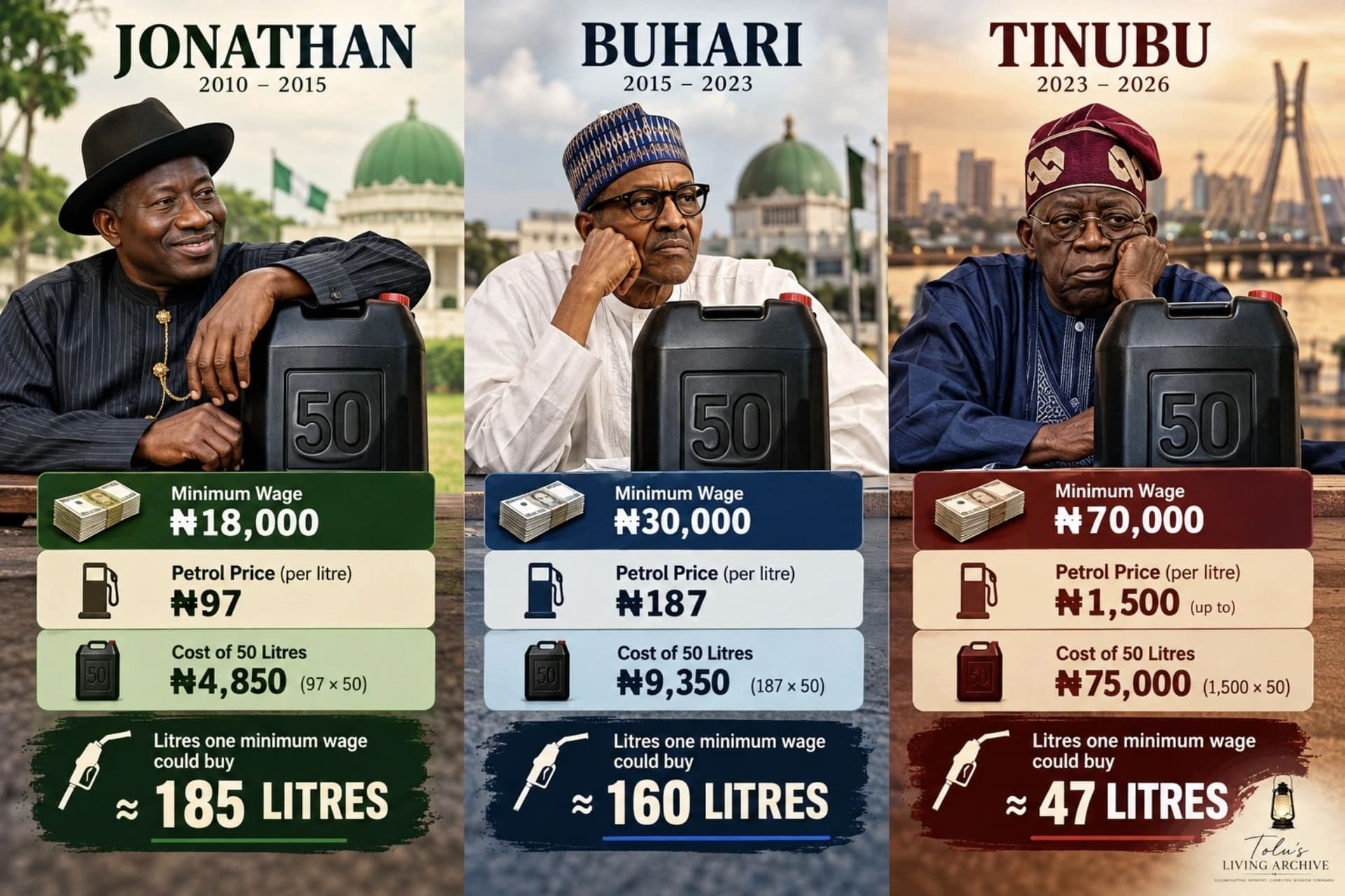
The statutory minimum wage is ₦70,000.
At NNPC pump price of about ₦1,405, 50 litres costs ₦70,250.
One jerrycan. More than one month’s minimum wage.
And we have not yet bought garri.
See, I understand the economics.
My problem is not that a foundation is being repaired.
My problem is that people cannot eat the foundation.
The whole point of stabilising an economy is surely that, somewhere down the road, stability enters ordinary life.
Jobs become easier to find. Wages buy more. Businesses breathe. Transport works. Electricity becomes less of a personal project. A trip to the pharmacy does not require a family meeting. School fees do not feel like an ambush.
Otherwise we have done something very Nigerian: confused the means with the miracle.
If you tell people to endure because tomorrow will be better, tomorrow eventually has to develop the courtesy to arrive.
The sadness for me is that we are beginning to separate the economy from the people living inside it.
As though the patient can be declared healthy while the body is still in pain.
So, yes, fix the macroeconomy. Fix the Naira. Build the reserves. Raise revenue.
Do the difficult things governments are elected to do.
But somewhere between the spreadsheet and the ordinary citizen, somebody must remember the purpose of all this repair.
Connect with @tolulivingarchive on @na-notesapp gift her 🎁 and read her journals
Because when every important number seems to be getting better except the number of things an ordinary person can, you stop asking whether the economy is improving.
You start asking:
Improving for whom?
culled from Tolulope Ariyibi-Oke | View @tolulivingarchive ’s profile on LinkedIn

Book a session with Emmanuel Adams
Native calendar, no redirect — payment collects inline.

Comments