
Journal
God Code: Practical Things You could Develop or Do With It

15 October 2026 | 4 min read
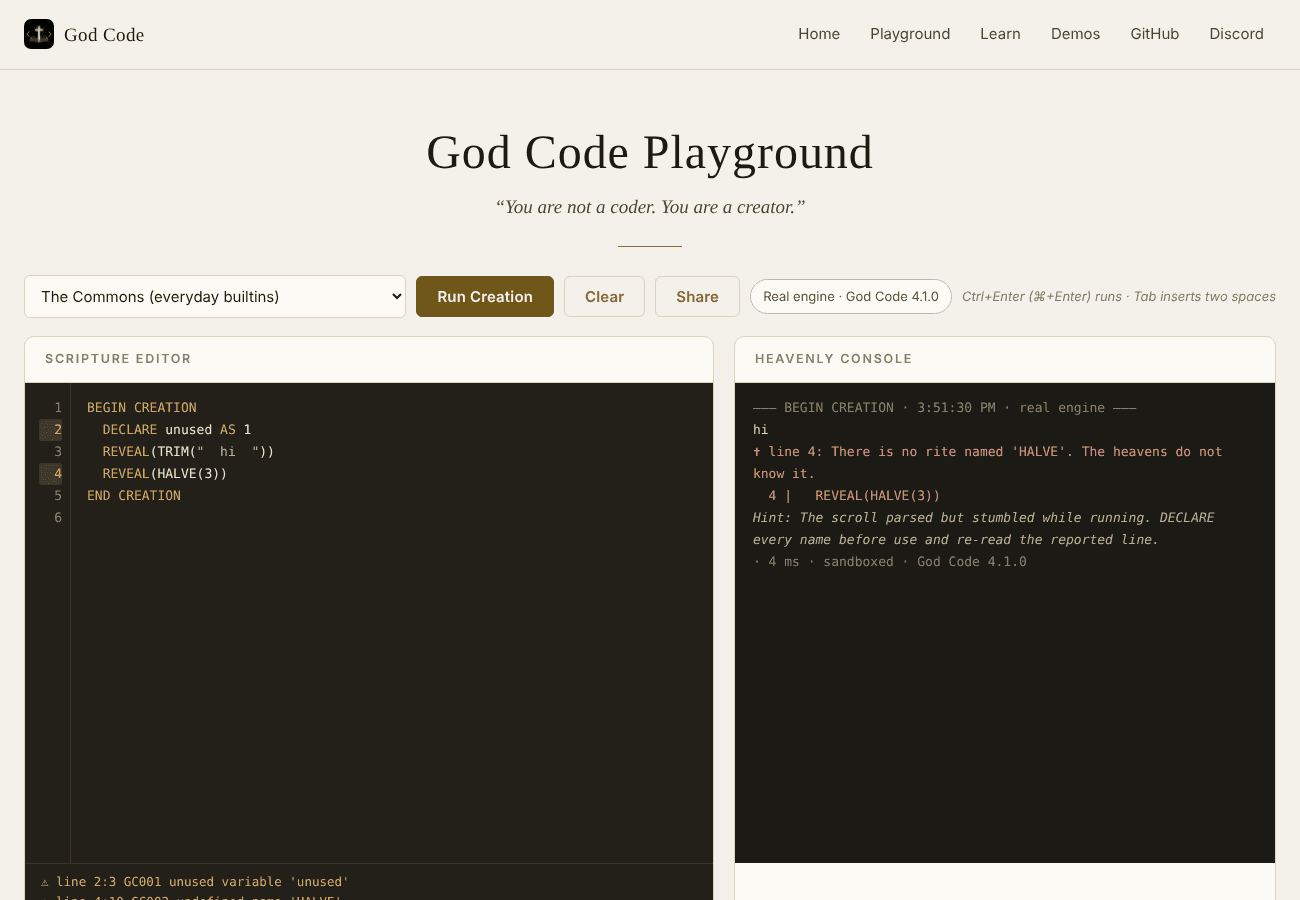
God Code is a small interpreted scripting language developed by @ala that runs on Python, so it's best for small, readable programs rather than big applications. Here's what people could realistically use it for, based on what the engine can actually do today.
Where it's strongest
1. Teaching programming in people's own language. This is its most distinctive strength. A child or adult can write real programs in Setswana, isiZulu, Igbo or Pidgin. The playground needs no installation, and the error messages are gentle ("Did you mean…?"). That suits schools, coding clubs, church youth programmes and community workshops, and an Igbo or Pidgin coding workshop is something we at Adams Consults could run.
2. Small everyday automation. It can read and write files, parse JSON, fetch web pages (HTTP_GET), handle dates, and sort, total and summarise lists. That covers jobs like:
- a monthly sales or offerings summary from a data file (
examples/sales_summary.godalready does this) - a daily report written to a text file (
examples/daily_report.god) - pulling exchange rates or other data from a web API and writing a summary
3. Tamper-evident records. SEAL adds entries to a local ledger where any later edit is detectable, and godcode ledger verify checks it. That's useful for meeting minutes, pledges, attendance or donation logs, where people want proof nobody changed old entries. Be clear with users that this is a file on their computer, not a real blockchain: the house rules forbid real chain calls and wallets.
4. Signing and fingerprints. SHA256 fingerprints a value (handy for spotting a changed document), and HMAC signs a message with a secret key. For example, a receipt or certificate could carry a code that anyone with the key can verify.
5. A safe place for AI-written code. This is the most commercially interesting angle. An AI agent can write God Code, check it (godcode check --json), and run it in a strict sandbox with no file, network or system access unless the program declares it (DECLARE PERMISSION TO …). There's also a bridge so AI tools can call it directly, which makes it a safe way to let an AI automate things.
6. A readable rules language inside other apps. Developers can embed it in a Python app and add their own functions through plugins (SUMMON). Non-programmers could then write the business rules themselves. For example, the admins of a church-management app could write "IF member IS new THEN send welcome" without touching the app's code.
7. Fun and creative programs: daily verse or blessing generators (the site's Daily Verse page does this), quizzes, interactive stories, and a local "oracle" (CONSULT).
What it's not suited for
Being honest helps set expectations:
- Websites, mobile apps, games with graphics: not supported; it runs text programs only.
- Big or fast data work: a tree-walking interpreter, roughly 140,000 loop steps per second. Fine for hundreds of records, slow for millions.
- Real money or blockchain: deliberately ruled out by the house rules.
- Programs that run several tasks at once, or talk to databases: not available yet (concurrency is on the roadmap).
A starter project idea
A pledge ledger for a church or NGO: read pledges from a JSON file, total them per person, SEAL each entry into the ledger, and write a monthly report. It could be written in Pidgin or Igbo for local teams. That one project shows off the tongues, file handling, the ledger, and readability together.
I wrote Market Day, an interactive story told three times: in English, Pidgin and Igbo. The three files are also in the playground’s sample list. All tests pass (1066). I also ran all three stories in a real browser.
The story. Ada walks to the Eke market with ten coins. The reader makes three choices, and they lead to one of three endings:
Choice English Pidgin Igbo The way to market "river" / "road" "river" / "road" "osimiri" / "uzo" The old woman at the gate "help" / "hurry" "help" / "rush" "nyere" / "oso" What to buy "yams" / "cloth" "yam" / "cloth" "ji" / "akwa" Let fate decide "fate" "fate" "chi" (your chi decides) Choices carry over: helping the old woman pays off later, because the cloth seller turns out to be her child. At the end, the story lists the steps of Ada’s journey.
How a reader plays it. The playground and the sandbox deliberately can’t read keyboard input. So the choices sit in three lines at the top of the scroll:
Change a word, press Run, and you get a different story. If someone types a choice the story doesn’t know, it says so gently and picks one at random instead.
1-english-a-opening The English story: the choices in the editor, the opening scenes, then “The Blessed Road” ending and Ada’s journey

2-pidgin-a-opening The same story in Pidgin: (OYA KREASHON, TALK … BE, SHOW, FINISH IF)

3-igbo-a-opening The Igbo telling: (MALITE OKIKE, KWUPỤTA, Ọ BỤRỤ … MGBE AHỤ), ending “Njedebe: Ụzọ Ngọzi”

Book a session with Emmanuel Adams
Native calendar, no redirect — payment collects inline.


Comments