
innovation🔒 Premium
Eden Mosquito Repellant


21 September 2026 | 12 min read
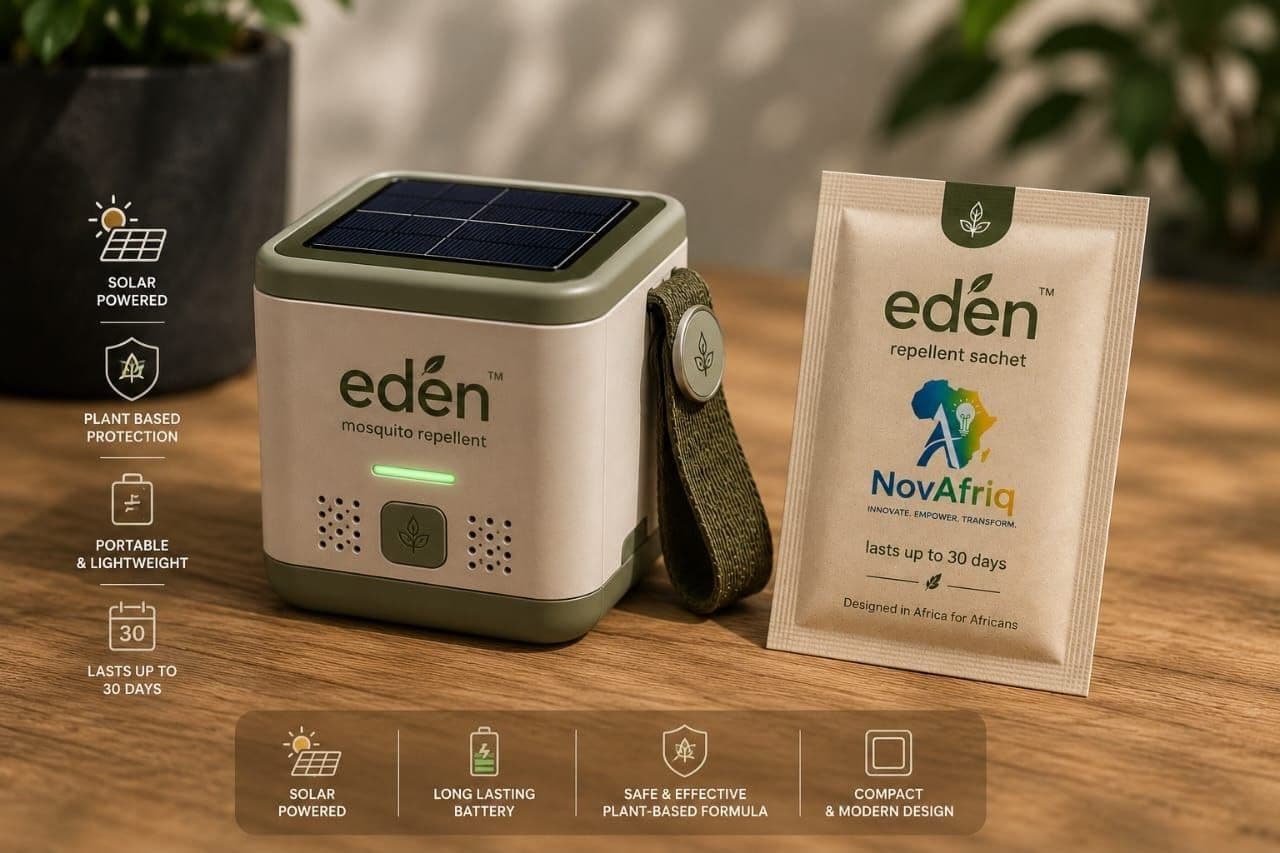
TECHNICAL BLUEPRINT AND INVENTION DESCRIPTION

EDÉN™ 3-IN-1 SOLAR MOSQUITO REPELLENT DEVICE
Invention Title: Portable Solar-Powered Botanical Mosquito Repellent with Integrated LED Lighting and USB Power Bank
Product Name: EDÉN™ Mosquito Repellent
Invention Category: Portable consumer electronics, solar energy systems, botanical insect-repellent delivery systems and multifunctional outdoor equipment.
Document Purpose: Preliminary technical specification for prototype development, engineering design, manufacturing consultation and intellectual property documentation.
1. ABSTRACT OF THE INVENTION
The EDÉN™ 3-in-1 Solar Mosquito Repellent is a compact, portable electronic device designed to provide mosquito-repellent functionality, LED illumination and portable power delivery in a single unit.

The device incorporates a solar photovoltaic panel, rechargeable lithium-ion battery system, electronic power-management circuit, low-noise air circulation fan, botanical mosquito-repellent material compartment, LED indicator or lighting system, and USB-C charging interface.
The proposed design features a detachable or ejectable solar panel assembly, a removable botanical material tray and a protective housing designed for convenient operation in homes, campsites, outdoor recreational areas and locations with limited access to reliable electricity.

The device is intended to utilise solar energy as a supplementary or primary charging source, depending on sunlight conditions and system configuration. Stored electrical energy powers the electronic components, while a controlled airflow mechanism facilitates the dispersion of volatile compounds from a suitable botanical repellent formulation.
The invention aims to integrate portable protection, renewable energy utilisation and electronic device charging into a convenient, reusable and potentially cost-effective product.
2. FIELD OF THE INVENTION
The invention relates to portable mosquito-repellent appliances and, more particularly, to solar-powered electronic devices incorporating a botanical repellent delivery mechanism, illumination functionality and a rechargeable power bank.

The invention falls within the fields of:
- Solar photovoltaic charging technology.
- Portable rechargeable electronic devices.
- Botanical insect-repellent delivery systems.
- Low-power fan and airflow engineering.
- LED lighting and battery management.
- Compact modular product design.
3. BACKGROUND OF THE INVENTION
Mosquitoes remain a significant nuisance in residential, commercial and outdoor environments, particularly in tropical regions where warm temperatures and seasonal rainfall can support mosquito populations.
Conventional mosquito-control products may depend on disposable chemical products, continuous electrical power, replaceable batteries or separate equipment for lighting and charging mobile devices.
These arrangements may be inconvenient for campers, travellers, households experiencing unreliable electricity supply and communities with limited access to charging infrastructure.
The EDÉN™ invention proposes a multifunctional alternative that combines a botanical repellent delivery system with solar charging, portable illumination and USB power output.
Its modular design is intended to simplify access to the solar charging assembly and repellent compartment for maintenance, cleaning and replenishment.
The proposed invention is designed to support convenient use while reducing dependence on disposable batteries and frequent external charging, subject to the capacity of its solar panel, battery and electrical load.
4. OBJECTIVES OF THE INVENTION
The principal objectives are to:
- Develop a compact device combining mosquito-repellent delivery, LED lighting and portable charging.
- Incorporate a photovoltaic panel to convert sunlight into electrical energy.
- Store energy in a rechargeable battery system.
- Provide a removable compartment for suitable botanical repellent material.
- Use controlled airflow to assist the distribution of repellent vapour.
- Incorporate a USB-C interface for charging and compatible external power delivery.
- Provide a simple user interface for controlling the device.
- Develop a durable, portable housing suitable for everyday and outdoor use.
- Make the device practical for markets where electricity access may be inconsistent.
- Support replaceable or replenishable consumable components to extend product service life.
5. GENERAL DESCRIPTION OF THE DEVICE
The proposed EDÉN™ device consists of the following principal assemblies:
5.1 Main housing
The main housing forms the protective enclosure for the internal electronics, battery, fan and repellent-delivery components.
The housing may be manufactured from suitable impact-resistant engineering plastic or another material selected for thermal stability, durability, weight and manufacturability.
The front surface includes the product branding, operating button, status indicator, airflow openings and USB-C interface.
The enclosure should protect the internal components against ordinary handling and accidental contact while permitting the airflow required for repellent distribution.
5.2 Solar photovoltaic panel
A photovoltaic panel is mounted on the upper surface of the device.
The panel converts incident sunlight into electrical energy for charging the internal battery through an appropriate charge controller.
The proposed design incorporates a detachable or ejectable panel mechanism to facilitate positioning, cleaning, replacement or servicing.
A mechanical retention system should secure the panel during normal operation and transport.
The panel output, charging time and energy contribution will depend on the selected photovoltaic technology, rated output, sunlight intensity, orientation and charging-circuit efficiency.
5.3 Rechargeable battery assembly
The battery assembly stores electrical energy generated by the solar panel or supplied through an approved external charging source.
The reference concept illustrates four cylindrical lithium-ion cells. The final cell chemistry, cell capacity, electrical arrangement and pack configuration must be established during engineering development.
The battery system should incorporate appropriate protection against overcharging, excessive discharge current, short circuits, undervoltage and excessive temperature.
Battery charging must be controlled by a compatible battery-management and charging circuit.
5.4 Botanical repellent compartment
The device includes a removable tray or cartridge intended to hold a suitably formulated botanical mosquito-repellent material.
The material may consist of dried botanical matter, a formulated botanical preparation or another compatible repellent substrate selected following laboratory evaluation.
The tray is intended to allow replacement or replenishment without requiring the user to dismantle the complete device.
The final botanical formulation must be evaluated for repellent effectiveness, stability, compatibility with the housing, user safety and applicable regulatory requirements.
5.5 Airflow and scent-diffusion assembly
A low-power fan is positioned within the device to produce controlled airflow through or around the repellent compartment.
The airflow is intended to facilitate the distribution of volatile compounds released by the selected repellent material.
Ventilation openings should be positioned to promote appropriate air movement while preventing direct access to moving components.
The fan should be selected according to its airflow capacity, electrical consumption, operating noise, expected service life and compatibility with the internal enclosure.
The effectiveness of the complete repellent-delivery system must be established through controlled testing. Fan operation alone does not establish mosquito-repellent efficacy.
5.6 LED lighting and status indication
An LED assembly provides operational status indication and may provide illumination as a separate product function.
The lighting system may indicate power status, charging activity, battery condition or operating mode.
If the product is intended to provide useful illumination rather than status indication alone, the LED output, beam distribution, heat dissipation and power consumption should be specified independently.
5.7 USB-C charging and power output
The device incorporates a USB-C interface for charging the internal battery and supplying power to compatible external devices.
The electrical design must distinguish between the USB-C input and output functions.
The final design should specify supported charging protocols, input voltage, maximum charging current, output voltage, current limits and protection features.
Power-bank functionality should be enabled only when the battery-management system confirms that the battery is within its permitted operating conditions.
5.8 User control interface
A front-mounted button provides user control over the supported operating modes.
Depending on the final electronic design, the interface may control the fan, LED lighting or other independently managed functions.
A visual status indicator may communicate operating state and charging status.
The button functions and indicator patterns should be defined in the final product requirements document.
5.9 Carrying strap
A detachable carrying strap is provided to facilitate portability.
The strap attachment points should be designed to withstand the expected carrying load and ordinary handling forces without damaging the enclosure.
6. PROPOSED PHYSICAL DIMENSIONS
The following dimensions are preliminary reference dimensions taken from the supplied concept blueprint.
| Parameter | Proposed specification | |---|---| | Main housing width | 88 mm | | Main housing height | 88 mm | | Main housing depth | 67 mm | | Overall width including strap | Approximately 105 mm | | Target device mass | Approximately 200 g | | Solar panel position | Upper surface | | External interface | USB-C | | Carrying strap | Detachable | | Repellent tray | Removable | | Solar panel assembly | Detachable or ejectable |
Engineering qualification: The proposed 200 g mass is a design target, not a verified weight. The final mass must be recalculated after selecting the battery cells, solar panel, housing materials, fan, electronics and tray assembly. A four-cell battery configuration may require a significant revision of this target.
7. ELECTRICAL SYSTEM SPECIFICATION
The electrical system should include the following functional blocks:
- Solar photovoltaic input.
- Solar charge controller with maximum-power-point tracking, if justified by the panel and system requirements.
- Protected rechargeable battery pack.
- Battery-management system.
- Regulated power supply for the fan and LED circuitry.
- USB-C charging input.
- USB-C power output.
- User control and status-indication circuitry.
- Overcurrent, overtemperature and short-circuit protection.
The system should prioritise safe battery charging and prevent incompatible power paths between the photovoltaic input, battery and USB-C interfaces.
The final circuit design must establish whether the device can charge its battery while simultaneously powering the fan, LED and external USB device.
8. PROPOSED OPERATING PRINCIPLE
The device operates through three principal functional systems.
Mode A: Mosquito-repellent delivery
The user installs an approved repellent cartridge or replenishes the removable tray with the designated formulation.
When the repellent function is activated, the fan produces controlled airflow through the designed scent-distribution path.
Volatile compounds from the selected formulation are carried into the surrounding air.
The required fan speed, airflow rate, formulation quantity and expected effective operating area must be determined through testing.
Mode B: Solar-powered illumination
The photovoltaic panel converts sunlight into electrical energy.
The charging circuit manages the energy supplied to the rechargeable battery.
The stored energy can subsequently power the LED lighting or status-indication system, depending on the product configuration and available battery charge.
Mode C: Portable power bank
The user connects a compatible electronic device to the USB-C output.
The power-management circuit supplies regulated electrical power from the battery within the limits of the selected components.
The system should disable or limit output when required to protect the battery and connected equipment.
9. MODULAR ASSEMBLY AND MAINTENANCE
The proposed device includes serviceable modules to simplify maintenance and component replacement.
The solar panel assembly should be removable using a defined release mechanism without damaging the photovoltaic cells or electrical connections.
The botanical repellent tray should be accessible through a separate release mechanism.
The battery and main circuit board should be serviceable through a controlled disassembly procedure intended for trained personnel.
The design should prevent accidental exposure to live electrical contacts, moving fan blades or battery terminals during ordinary user maintenance.
Replacement components should be mechanically and electrically keyed where practical to minimise incorrect installation.
10. MATERIALS AND COMPONENTS
The following components are proposed for prototype development:
- Solar photovoltaic panel sized to the available upper surface.
- Rechargeable lithium-ion battery pack selected to meet the required energy capacity and mass target.
- Battery-management and solar-charging circuitry.
- Low-power brushless DC fan.
- LED illumination and status-indication components.
- USB-C input/output connector and supporting power circuitry.
- Microcontroller or discrete control circuit, depending on the required functionality.
- Removable botanical repellent tray or cartridge.
- Protective enclosure made from suitable engineering polymer.
- Mechanical panel-release and tray-release assemblies.
- Detachable carrying strap.
- Internal wiring, connectors, seals and mounting hardware.
Final component selection should be based on electrical compatibility, safety, supply availability, cost, durability and manufacturing feasibility.
11. PROPOSED MANUFACTURING PROCESS
The product may be developed through the following stages:
- Prepare detailed computer-aided design models of the housing, solar panel mount, tray and strap attachment.
- Develop the electronic schematic and printed circuit board layout.
- Select and validate the photovoltaic panel, battery pack, fan and power-management components.
- Manufacture an initial enclosure prototype using 3D printing or another suitable prototyping process.
- Assemble the electrical modules and verify the charging and power-output functions.
- Evaluate fan airflow and the distribution characteristics of the selected repellent formulation.
- Test the panel-release and tray-release mechanisms for durability.
- Conduct electrical, mechanical, thermal and environmental testing.
- Revise the prototype according to the test results.
- Develop production tooling and manufacturing documentation after design validation.
12. TESTING AND VALIDATION REQUIREMENTS
Before commercial release, the following tests should be completed.
Electrical testing: Verify solar charging, USB-C charging, regulated power output, battery protection, current limits and simultaneous operation where supported.
Battery safety testing: Evaluate charging behaviour, temperature rise, short-circuit protection, mechanical integrity and applicable battery safety requirements.
Solar performance testing: Measure actual panel output under specified lighting conditions and determine charging performance under representative outdoor conditions.
Repellent efficacy testing: Evaluate the selected formulation and complete delivery system using an appropriate controlled mosquito-repellency test protocol.
Airflow testing: Measure fan airflow, noise, power consumption and distribution through the repellent compartment.
Mechanical testing: Test the enclosure, carrying strap, panel retention, tray release and resistance to ordinary impacts.
Environmental testing: Assess performance under relevant temperature, humidity, dust and moisture conditions.
User safety testing: Assess the risks associated with botanical ingredients, airborne exposure, skin contact, accidental ingestion, heat generation and access to internal components.
All performance claims, including operating duration, effective repellent range and battery life, should be based on documented test results rather than assumptions.
13. PRELIMINARY INVENTION FEATURES
The proposed features that may warrant further technical and intellectual-property investigation include:
- A compact housing integrating botanical repellent delivery, solar charging and USB power delivery.
- A detachable or ejectable photovoltaic panel integrated into the housing.
- A removable botanical repellent tray combined with a controlled airflow path.
- A shared rechargeable power system supplying the repellent-delivery mechanism, lighting and external power output.
- A modular layout designed to provide separate access to the solar panel and repellent tray.
- A portable form factor combining these functions in one enclosure.
These features describe the proposed concept; they are not a determination that the invention is new, patentable or free from third-party intellectual-property rights.
14. POTENTIAL APPLICATIONS
The device may be developed for use in:
- Residential settings.
- Camping and outdoor recreation.
- Travel and temporary accommodation.
- Outdoor markets and recreational spaces.
- Locations experiencing unreliable electricity supply.
- Emergency kits and selected field applications.
The suitability of each application will depend on validated performance, durability, safety and the repellent formulation used.
15. CONCLUSION
The EDÉN™ 3-in-1 Solar Mosquito Repellent is a proposed multifunctional portable device intended to integrate botanical mosquito-repellent delivery, solar-powered energy storage, LED lighting and USB-C power delivery.
Its key design proposition is the integration of these functions into a compact, serviceable enclosure with a removable solar panel and replaceable repellent compartment.
The next stage of development should establish the final component specifications, battery capacity, photovoltaic output, operating duration, airflow requirements, repellent efficacy and mechanical tolerances through engineering calculations and prototype testing.
END OF PRELIMINARY INVENTION BLUEPRINT

Document status: Concept-stage technical description. Not yet a validated production specification or patent claim set.
🔒 This entry is for Emmanuel's subscribers
Subscribe to unlock every premium entry in this journal.
Book a session with Emmanuel Adams
Native calendar, no redirect — payment collects inline.




Comments